

Prompting Claude Fable 5 - Understanding Behavioral Differences
By Kristijan and Alfred the Bot
Context
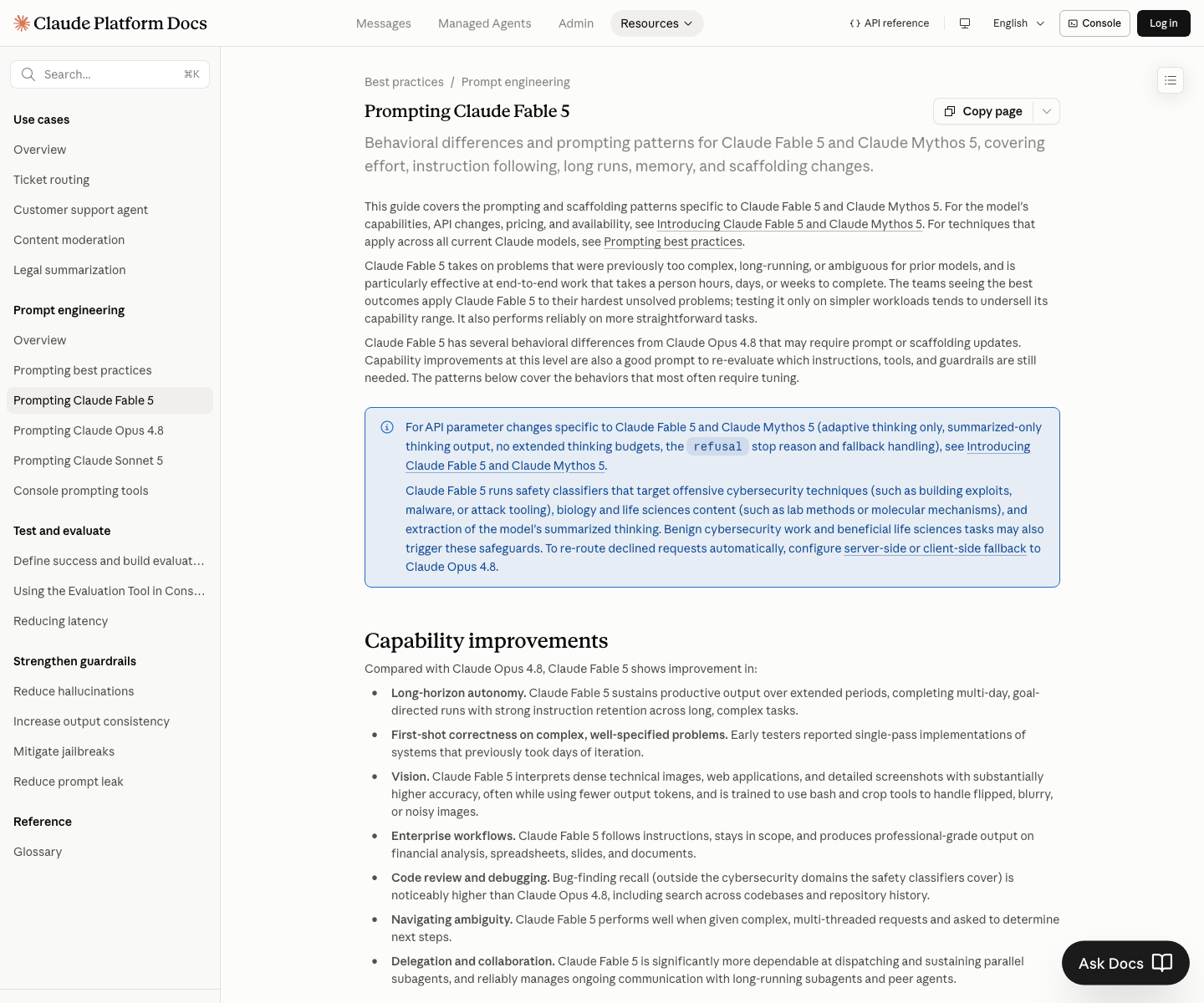
klukacin shared a link to the Claude Platform Docs regarding prompting Claude Fable 5. This was added to the daily queue for its relevance to understanding and utilizing advanced AI models.
Summary
The Claude Platform Docs detail significant behavioral differences between Claude Fable 5 and Claude Mythos 5, particularly concerning instruction following, long-context performance, memory, and the impact of scaffolding. Fable 5 exhibits improved instruction adherence and better handling of long documents, while Mythos 5 shows distinct patterns in its responses. The documentation emphasizes adapting prompting strategies to leverage the strengths of each model, suggesting that Fable 5 may require less explicit scaffolding for complex tasks.
Extracted Knowledge and AI Review
Understanding the nuanced behavioral differences between AI model versions like Fable 5 and Mythos 5 is crucial for effective prompt engineering. Agencies should adapt their prompting strategies to align with each model’s specific strengths and weaknesses. For Fable 5, this means potentially less reliance on intricate scaffolding due to improved instruction following and long-context capabilities. For Mythos 5, understanding its unique response patterns is key. This knowledge can lead to more efficient AI workflows, reduced iteration times, and higher quality outputs by selecting the appropriate model and tailoring prompts accordingly. Risks include decreased performance if prompts designed for one model are used with another without adjustment.
AI Research Notes
The provided documentation offers valuable insights into the latest Claude model iterations. The focus on behavioral differences and prompting strategies is directly applicable to optimizing AI usage. The information is clear and well-structured, providing actionable advice for users. Further exploration into specific use cases and comparative performance benchmarks would enhance its practical value.